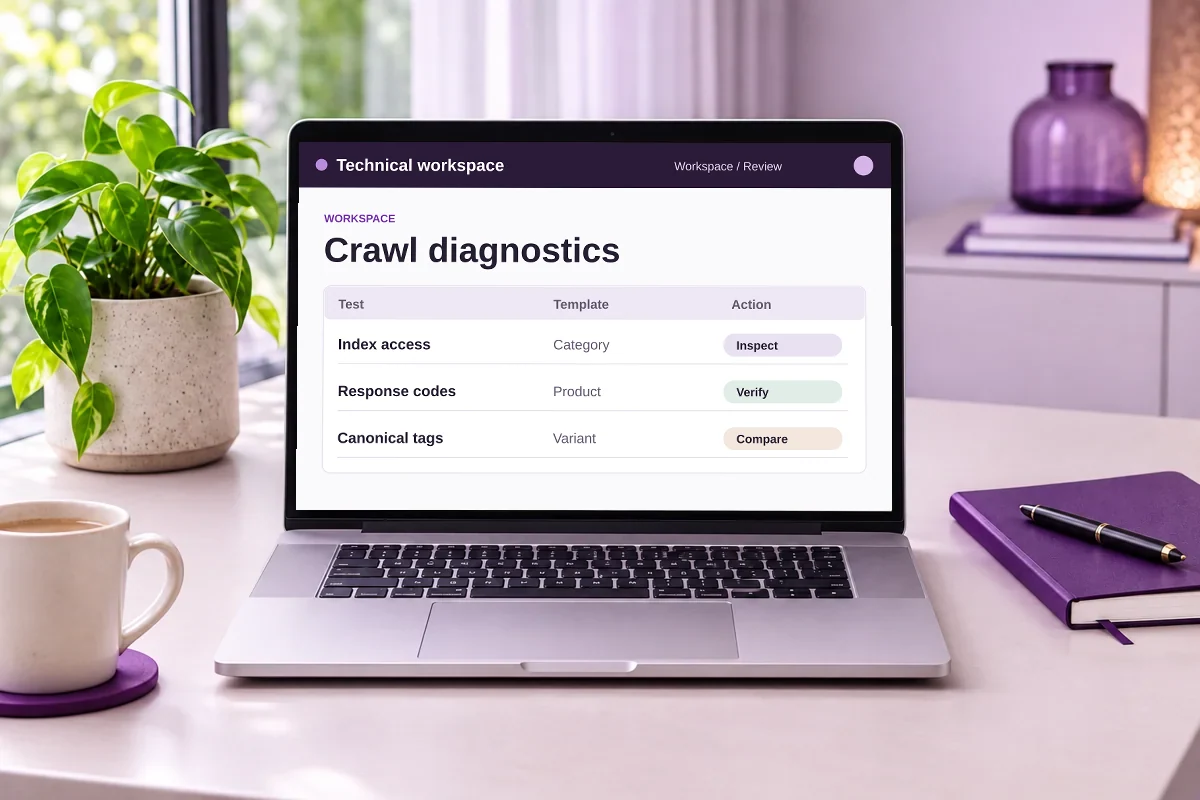
Important pages are missing
A page can be live yet difficult to discover, blocked from crawling, marked noindex or consolidated into another URL. We check the affected page types and Search Console evidence before proposing a fix.

Search · Technical SEO
Help search engines reach your important pages—and help visitors take the next step. MayaWeb turns crawling, indexing, rendering and performance issues into a practical plan for your website.
START WITH THE SYMPTOM
A change in visibility is a reason to investigate. The symptom alone does not tell you the cause.
A page can be live yet difficult to discover, blocked from crawling, marked noindex or consolidated into another URL. We check the affected page types and Search Console evidence before proposing a fix.
Large assets, long JavaScript tasks, slow responses and shifting layouts can interrupt a visitor’s journey. We examine real-user signals where available and reproduce problems on representative templates.
New routes, templates or navigation can alter how search engines and customers reach content. We compare what changed, check redirects and indexing signals, and separate technical findings from other possible causes.
THE FOUNDATION
Technical SEO improves how a website can be discovered, crawled, rendered and indexed, while supporting a usable experience for the people who visit it.
Internal links, sitemaps and server responses help crawlers reach the URLs that matter.
Important copy, links and page signals need to be available when a search engine processes the page.
Consistent canonical and indexing signals help describe which pages should be considered for search.
Responsive layouts, stable pages and reliable interactions help visitors use what they find.
Technical health supports your wider SEO strategy. Useful content, search intent and competition still matter; indexing and rankings are never guaranteed.
A COMPLETE TECHNICAL PICTURE
A technical SEO audit examines the systems behind your website: how pages are discovered, crawled, rendered and indexed, and how well they work for visitors. It connects technical findings to the pages and journeys that matter to your business.
MayaWeb brings the findings together in a prioritised action plan, with URL examples, recommended fixes and clear validation steps. These nine areas form the core of the review.
We review robots.txt, XML sitemaps, canonical tags, status codes and indexing directives to understand whether search engines can reach your important pages. You receive affected URLs and a practical plan to resolve unintended restrictions.
We investigate oversized images, render-blocking resources, caching and slow server responses. Recommendations focus on the templates that matter most, with a baseline and a repeatable method to check the improvement.
We assess loading, responsiveness and visual stability using LCP, INP and CLS. Field data, where available, helps identify real visitor problems; controlled tests help diagnose the code and assets behind them.
We check whether essential content and links are available when your pages render. We also investigate heavy scripts and long tasks, then recommend changes that improve responsiveness while preserving the features visitors use.
We identify broken internal links, redirect chains and incorrect destinations. Each recommendation reflects the purpose of the URL: restore useful content, update a link, or redirect to a genuinely relevant replacement.
We review mobile behaviour, hosting response, asset delivery and key interactions across representative pages. The outcome is a coordinated performance plan for the platform, templates and visitor journeys that need attention.
We check HTTPS redirects, certificate issues and mixed content that can interrupt access or undermine trust. Findings include the affected resources and steps for your development or hosting team to verify the corrections.
We review suitable schema types, required properties and consistency with visible page content. You receive recommendations and validation checks that help search engines interpret the page and assess eligibility for supported search features.
We map repeated or near-duplicate URLs, including filters, parameters and alternate versions. The audit recommends where to retain distinct pages, consolidate content, or align canonical and internal-link signals around a preferred URL.
Clear priorities. Page-level evidence. Fixes your team can act on.
SERVICE SCOPE
Choose a focused investigation or a broader programme. These are the workstreams we can scope around your website.
Check whether priority URLs are reachable, return the intended response and are eligible for indexing. We compare crawl findings with Search Console, sitemaps, robots directives and canonical signals to investigate exclusions in context.
What you receiveAn affected-URL list with causes, recommended actions and checks to run after release.
Review the journey from navigation and category pages to commercial content. Identify orphan pages, unnecessary depth and links that depend on user interaction, then recommend a structure that visitors and crawlers can follow.
What you receiveA linking and template plan for priority page groups.
Investigate loading, interaction delays and layout movement across important templates. Review images, fonts, scripts, caching and server response with your development team; use field data and controlled tests for different purposes.
What you receiveA prioritised performance backlog with a baseline and retest method.
Check that mobile visitors can read content, use menus and complete forms. Compare important content, metadata, links and structured data across device experiences, especially where separate mobile templates exist.
What you receiveDevice-specific findings and practical acceptance checks.
Compare initial HTML with rendered pages to check content, links, metadata and status handling. Investigate blocked resources, client-side routing and delayed content, and assess server rendering or pre-rendering where appropriate.
What you receiveRendering evidence and implementation guidance suited to your application.
Map duplicate and near-duplicate URLs from parameters, product variants, filters and alternate routes. Align canonical annotations, internal links and sitemaps; choose redirects or indexing controls according to the purpose of each URL.
What you receiveURL rules for the relevant templates, including exceptions worth keeping.
Review sitemap contents, freshness and discoverability. Check robots.txt, meta robots and response headers together. Robots.txt controls crawling; a blocked URL can still appear in search, and a crawler must access a page to see its noindex directive.
What you receiveA coordinated crawl and indexing configuration, with test cases.
Find broken internal journeys, redirect loops and chains, soft 404s and unexpected server errors. Preserve genuine removals where appropriate and map moved pages to relevant destinations rather than sending every old URL to the homepage.
What you receiveA redirect or repair list with expected HTTP responses and destinations.
Match supported schema types to visible content and real business facts. Check syntax, required properties and template consistency. Structured data can clarify meaning and support eligible search features; it does not guarantee an enhanced result.
What you receiveValidated JSON-LD recommendations and a template-level maintenance plan.
For large or frequently changing sites, review server logs when available to understand bot requests, status codes and crawl patterns. Investigate excessive URL combinations or inaccessible priority pages before treating crawl budget as the problem.
What you receiveEvidence of crawl behaviour, clearly separated from crawler-tool estimates.
Check HTTPS consistency, mixed content and redirect behaviour. For multilingual or regional sites, review language URLs, reciprocal hreflang annotations and compatible canonicals. Technical SEO checks do not replace a specialist security assessment.
What you receiveA signal-consistency checklist for the markets and templates in scope.
Review URL changes, redirects, metadata, analytics, navigation and indexing controls before a move. Agree checks with the people releasing the site, validate on launch, and monitor important pages afterwards.
What you receiveA migration checklist, URL map and agreed post-launch review. Explore SEO migration support →
Your proposal confirms the URLs, templates, access, implementation tasks and validation included. Specialist work is selected for your website, not added simply to make a longer checklist.
A USEFUL AUDIT
The value of a technical SEO audit is the decisions it makes possible. Findings should explain the evidence, the business relevance and the next action.
Need a wider review of content and authority as well? See our SEO audit services.
FROM DIAGNOSIS TO DELIVERY
A structured review, a clear order of work, and checks after release. Explore the workstreams we can scope around your website.
We begin with your business goals, priority pages, recent changes and platform constraints. Crawling, Search Console evidence and manual checks establish a baseline. Findings become a prioritised backlog with clear responsibilities and acceptance checks.
What you getA scoped audit and a sequenced action plan.
We investigate unintended crawl restrictions, noindex directives, canonical conflicts and sitemap issues. Recommendations focus on making your important public pages accessible and their indexing signals consistent.
What you getURL-level findings and checks for crawl and index eligibility.
We diagnose loading bottlenecks across representative templates, including images, fonts, scripts, caching and server response. Agreed changes are tested under comparable conditions to assess their impact.
What you getA performance baseline, prioritised fixes and retest results.
We review responsive layouts, navigation, tap targets, forms and important content on small screens. Template recommendations address the points where mobile visitors struggle to read, explore or enquire.
What you getDevice-specific findings and usable mobile acceptance checks.
We review technical on-page elements such as title tags, descriptions, headings, canonical tags and internal links. These recommendations align each template with its purpose and the wider content strategy.
What you getTemplate-level recommendations for clear, consistent page signals.
We assess content structure, duplicate page patterns and the relationship between navigation, categories and commercial pages. Recommendations help your team decide where to consolidate, strengthen or better connect existing content.
What you getA content-structure plan linked to priority pages and search intent.
We select appropriate structured data for the agreed page types, align it with visible content and validate the markup. Implementation and release responsibilities are confirmed with your team.
What you getValidated markup for the agreed templates and a record of remaining issues.
We review HTTPS access, certificate problems, mixed content and secure URL consistency. Relevant corrections are agreed with your hosting or development team and verified after release.
What you getA focused HTTPS checklist and confirmation of the agreed fixes.
We compare post-release evidence with the baseline and watch for regressions. Where ongoing work is included, reporting follows technical health, visibility and agreed enquiry or conversion events.
What you getA validation record and an agreed monitoring cadence.
We review internal navigation, orphan pages, broken links and redirect chains. Fixes make important content easier to reach, with appropriate destinations and checks that links work after deployment.
What you getAn actionable link map, repair list and post-release checks.
Your proposal confirms the included workstreams, access and responsibilities. Audit-only work ends at the agreed handover; implementation and ongoing monitoring are scoped separately.
FIX WHAT MATTERS
A tool warning is a starting point. Business importance, affected templates, evidence and implementation risk determine what should move first.
| Priority | Example finding | First decision | How to verify |
|---|---|---|---|
| Investigate immediately | Key commercial pages unexpectedly blocked or returning server errors | Confirm the intended public state and the affected scope | Live responses, crawl access and indexing directives |
| Plan the next release | Template-wide incorrect canonicals, inaccessible links or broken redirects | Agree the URL and template rules before editing | Representative URL tests plus a crawl of affected templates |
| Improve with evidence | Slow interaction or unstable layouts on high-value journeys | Identify the bottleneck and likely user impact | Repeatable lab tests and real-user data when sufficient |
| Review in context | Minor warnings on non-priority pages or intentional exclusions | Decide whether a change is useful at all | Document the decision and any monitoring needed |
PERFORMANCE THAT PEOPLE FEEL
Page speed is more than one score. We look at loading, responsiveness and stability on the templates your customers actually use.

How quickly the largest visible content element appears.
How quickly the page responds visually to user interactions.
How much visible content shifts unexpectedly.
These are Google’s “good” thresholds, assessed at the 75th percentile of real-user visits. They are measurement targets, not MayaWeb results or a ranking promise. Read the Core Web Vitals guidance.
Controlled tests help reproduce slow loading, layout movement and long tasks. Device and network settings must be recorded so comparisons are meaningful. A Lighthouse score is not a field INP measurement.
CrUX, Search Console and appropriate real-user monitoring can reveal actual experiences. Small sites may not have enough data; report that limitation rather than treating missing data as a pass.
FIT THE WEBSITE
We scope the work around your CMS, templates, development access and release process.
Review themes, plugins, archives, duplicate routes and template output. Changes need to preserve editorial workflows and useful content. WordPress SEO services →
Investigate collections, variants, faceted navigation, pagination and product availability. Platform constraints determine which fixes are practical. Ecommerce SEO services →
Review routing, rendering, API-dependent content and deployment behaviour with the developer. Link discovery and server responses need particular attention.
Check location or language templates, navigation and indexing signals without creating repetitive pages. Connect the technical scope with your Local SEO strategy.
CHANGE WITH A PLAN
A redesign, domain change or platform move can alter many search signals at once. No migration is risk-free; preparation makes problems easier to prevent and detect.
BEFORE LAUNCH
AT LAUNCH
AFTER LAUNCH
Plans & pricing
Choose the type of support first. We confirm the workload and price after understanding your website.
Audit. A defined investigation and handover for a team that wants clear technical priorities.
QUOTED TO SCOPE
Request a Quote
USD · scope agreed in your proposal
Implementation. For an existing audit or a scoped set of fixes that needs development coordination.
QUOTED TO SCOPE
Request a Quote
USD · scope agreed in your proposal
Ongoing. For websites with regular releases, expanding content or recurring technical needs.
QUOTED TO SCOPE
Request a Quote
USD · scope agreed in your proposal
For migrations, large catalogues, international websites or specialised requirements.
TAILORED SCOPE
Request a Quote
USD · scope agreed in your proposal
Website size, template variety, JavaScript complexity, available data, migration risk, implementation responsibility and review frequency all affect the work. The proposal identifies deliverables, exclusions, any third-party costs and payment terms before you commit.
WHY MAYAWEB
Get a clear explanation of what is holding your website back, a practical order for the work, and a team that understands your business goals.
Your commercial pages, audience and business goals shape the audit. We agree the most useful starting point and prioritise issues that affect the journeys you want to improve.
Search Console, crawlers and performance tools help uncover issues. We combine their findings with manual checks and your platform context to decide which warnings need action.
We establish a baseline and track what changed: resolved technical issues, search visibility and useful actions such as enquiries. Reporting connects the work to agreed business goals.
You can see what we found, why it matters and what should happen next. Scope, responsibilities, dependencies and additional work stay visible throughout the engagement.
Recommendations account for your CMS, hosting, development resources and release schedule. Implementation support can be scoped alongside MayaWeb’s website development services.
You receive plain-language explanations alongside affected URLs, evidence and developer guidance. Each priority has a suggested next action and a way to check whether the fix worked.
Explore our case studies and discuss the examples most relevant to your needs. We explain the scope of each project and distinguish wider marketing outcomes from verified technical changes.
TECHNICAL FOUNDATIONS. BUSINESS FOCUS.
Help the right people find your pages, use your website and take the next step. Our technical SEO strategy connects the work behind the scenes to your wider growth goals.
Book a discovery callProgress is measured against your baseline and agreed goals. Traffic, leads and rankings depend on the wider strategy and market conditions.
Identify crawling, rendering, indexing and performance barriers on the pages that matter to your business. The audit sets the priorities for the work that follows.
Connect priority landing pages with relevant searches, customer intent and commercial relevance. Use that context to guide technical and content decisions.
Combine crawl evidence, analytics, search data and manual review. Prioritise by impact, confidence and implementation effort, then define how progress will be checked.
Investigate why important pages are excluded from search. Address unintended restrictions and conflicting signals while preserving intentional exclusions.
Keep sitemaps focused on appropriate canonical URLs and review crawler access rules. Robots.txt controls crawling; it is not a reliable way to keep a page out of search.
Check how content, internal links and page signals render. Work with your developers to resolve access and responsiveness issues within the application’s architecture.
Address confirmed bottlenecks in images, code, caching and hosting response. Test key landing pages and enquiry journeys under comparable conditions.
Track LCP for loading, INP for responsiveness and CLS for visual stability. Use real-user evidence where available and diagnostic tests to guide improvements.
Repair broken internal links and resolve unintended missing pages. Redirect only where a relevant replacement exists, then retest the paths visitors and crawlers follow.
MEASURE WHAT CHANGED
A fix can be correct before search performance changes. We report implementation evidence separately from organic outcomes.
Track the relevant status codes, crawl paths, indexing directives, rendered content, template output and performance checks. Record retests against the agreed acceptance criteria.
Review indexing, impressions, clicks and affected landing-page groups in Search Console. Annotate releases and compare suitable time periods rather than attributing every fluctuation to a fix.
Where measurement is configured and permitted, review qualified enquiries, purchases or other relevant actions. Account for consent, tracking gaps, content changes and seasonal demand.
The reporting cadence, tools and metrics are confirmed in your scope. Organic outcomes depend on more than technical implementation.
CHOOSING THE RIGHT SERVICE
These services overlap, but they answer different questions. Choose the starting point that matches the problem.
| Service | Main question | Typical focus |
|---|---|---|
| Technical SEO | Can engines and people access and use the website properly? | Crawling, rendering, indexing, architecture, performance and releases |
| On-page SEO | Does each page answer the right search need clearly? | Content, titles, headings, relevance and contextual links |
| Local SEO | Can relevant nearby customers discover the business? | Business Profile, location content, listings and reputation |
| Broader SEO audit | What is limiting overall organic performance? | A combined review of technical, content and authority factors |
TOOLS WITH A PURPOSE
No single tool shows the whole website. Tool selection, licences and access depend on the agreed work.
Access is requested for the task that needs it. Use account invitations and appropriate permissions; do not send passwords in an enquiry.
Clear answers about scope, cost, implementation and expectations.
The scope can include crawling, indexing, rendering, architecture, mobile experience, performance, redirects, canonical URLs, structured data and migration checks. Your proposal defines which templates and URLs are covered, who implements changes, and how the work is validated.
An audit investigates the website and produces findings and recommendations. Implementation changes the website or its configuration. They can be purchased together or separately; we agree ownership and access so you know who is responsible for delivering each fix.
The price depends on the site’s size, templates, platform, data access and the work required. A focused audit is different from a migration or ongoing implementation support. MayaWeb provides a scoped quote in USD, including deliverables and relevant exclusions, before work begins.
Timing depends on access, site complexity, crawl coverage and the depth of manual investigation. Implementation introduces separate development and release dependencies. We confirm milestones in the proposal rather than promise a universal turnaround.
Some implementation effects can be checked immediately, such as a corrected status code or removed noindex directive. Search engines still need to process changes, and organic outcomes depend on content, competition and other factors. There is no guaranteed ranking or traffic timeline.
Yes, the engagement can be scoped around your existing team. Findings can include URL examples, the intended template behaviour and acceptance checks. Your proposal confirms who edits the code, who approves releases and which post-release reviews MayaWeb provides.
Start with confirmed problems affecting important public pages, such as unintended crawl restrictions or server errors. Then assess template-wide signal problems and user-experience barriers. The right order depends on reach, business impact, confidence, dependencies and change risk.
No. It is primarily relevant to large or frequently changing websites and specific discovery problems. A small site should usually begin with clear navigation, useful pages, correct indexing signals and an accurate sitemap. We investigate the evidence before recommending advanced log work.
Not reliably. Robots.txt limits crawling, and a disallowed URL can still be known and appear in search. To remove a page from indexing, a suitable noindex directive generally needs to be accessible to the crawler; private content should be protected with authentication.
Not automatically. Multiple URLs can show similar content for ordinary platform reasons. The task is to decide which versions serve a purpose and align canonical, redirect and internal-link signals. A traffic decline alone is not evidence of a manual action.
No. Core Web Vitals are used by Google’s ranking systems, but a good score does not guarantee a top position. Performance work should improve real journeys and address confirmed bottlenecks, alongside useful content and a wider search strategy.
A sound technical foundation helps a page meet the ordinary requirements for discovery and indexing. Google states that no additional technical requirements or special schema are needed for its AI search features. Inclusion or citation cannot be guaranteed.
The work can cover a URL inventory, destination mapping, redirect checks, metadata and signal preservation, launch validation and post-launch monitoring. We agree the launch responsibilities and contingency plan with your team. Rankings can fluctuate during a move.
Match the review schedule to change frequency and risk. A site with frequent releases, a large catalogue or a migration may need closer monitoring than a small, stable website. Significant changes or unexpected performance problems are useful triggers for a fresh review.
An initial discussion can start with the website URL and a description of the problem. Deeper work may need Search Console, analytics, staging, CMS or server-log access. We agree the minimum access and permissions required for the scope.
You can review the MayaWeb portfolio and ask which examples are relevant to your website. We will distinguish a broader SEO or development project from evidence that specifically demonstrates technical work. We do not present competitor results as MayaWeb results.
BEFORE WE BEGIN
You don’t need to diagnose the problem yourself. Bring what you know; we’ll identify what needs investigating.
Tell us which pages matter most, what you have noticed, and whether a redesign, migration or recent release is involved. An existing audit is useful too.
If you have a deadline or an internal developer, mention that early so the scope can reflect the real constraints.
WHERE IDEAS MEET RESULTS
Start with the problem that matters to your business. Let’s turn it into a focused technical SEO plan.
MayaWeb · Chandigarh, India · +91 95011 56566